
Concept-stage fire suppression platform
QuenchPod™
Get the extinguisher to the fire
Remote suppression. Rapid deployment. Safer firefighting.
The problem
Fire moves fast
One of the oldest challenges in firefighting has not changed: getting enough suppression onto a fire without putting another human life inside the hazard.
- Crews must often reach the fire before the agent does
- Interior and roadside entry carries the highest risk
- Wildland fronts move faster than crews can be placed
The cost of delay
Every second of unsuppressed growth makes the fire harder and more dangerous to fight.
The question
What if the extinguisher could go first?
Firefighters would not always have to reach the fire before the agent does. The pod goes in. The crew stays back. The attack starts sooner.
3 / 27The concept
QuenchPod in action
A proposed scalable remote-deployment fire suppression platform: a sealed pod is placed or delivered to the fire, opens, and rapidly disperses a proven firefighting agent.
The agents
Cooling and re-ignition resistance
Cooling
Every QuenchPod agent carries water. As it contacts burning material the water flashes to steam, absorbing a very large amount of heat and pulling the fuel back below its ignition temperature. Wetting agents in Class A foam lower surface tension so the water soaks into timber and furnishings and cools deep-seated burning, not just the surface.
Re-ignition resistance
Once the flames are down, the foam blanket stays. It seals the fuel surface, holds flammable vapour beneath it and excludes oxygen, which is why a foam-covered fire resists flash-back long after knock-down. On vehicle and fuel fires a fluorine-free (F3) Class B foam forms that seal over spilled liquid; on vegetation, superabsorbent water-enhancing gel clings to fuels for hours and shields them from radiant heat.
Proven agents, new delivery
QuenchPod does not propose a new chemistry. It carries agents already used in the fire service every day — Class A and fluorine-free Class B foam concentrates, compressed-air foam, water with wetting agent, ABC dry chemical powder, wet chemical, and water-enhancing gel or long-term retardant. The concept is the delivery, not the agent.
The second mode
Two ways to use it: deployed, or already in place
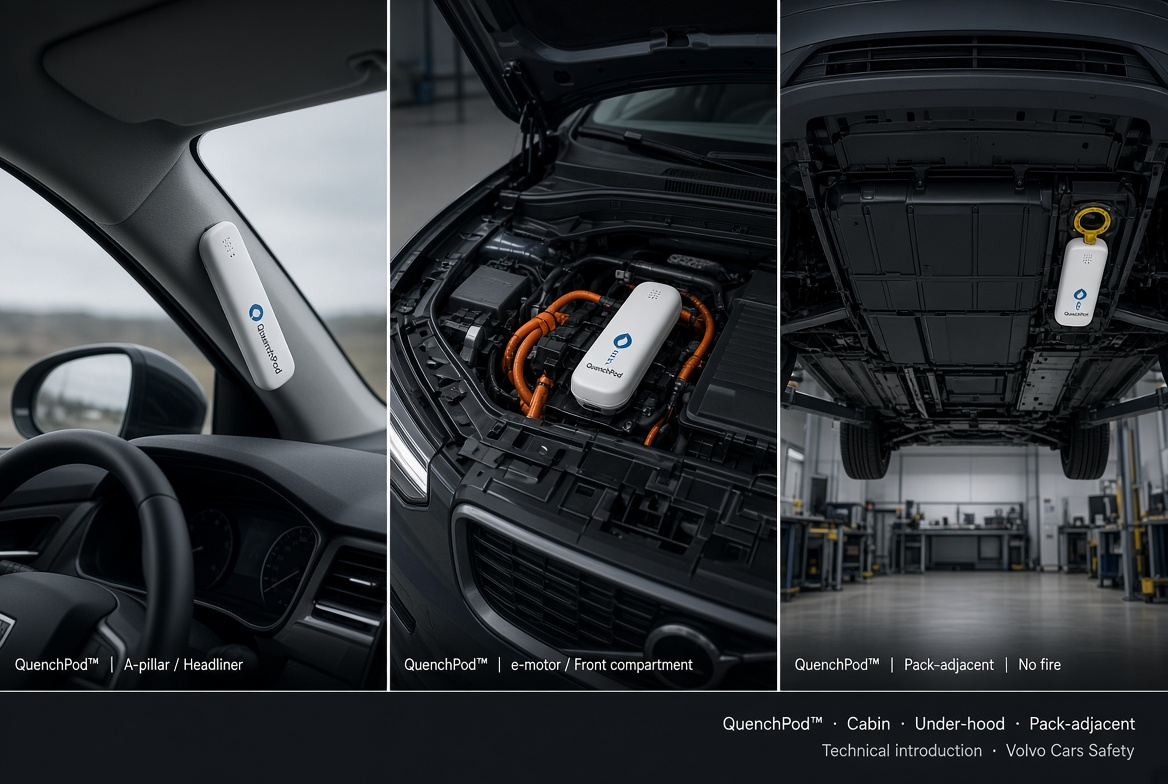
QuenchPod does not have to arrive with the fire service. A pod can be pre-installed in advance, sitting dormant in the space it protects, so suppression is already at the seat of the fire before anyone is alerted.
Fixed in place, ready to act
Mounted in a kitchen, plant room, server room, workshop, engine bay, battery or charging area, storage unit or roof void — wherever a fire is most likely to start and least likely to be seen early.
Triggered locally or remotely
A pre-installed pod is intended to be activated by a local heat or smoke trigger, or remotely by an occupant, alarm panel or arriving crew, so it can act in the first seconds rather than the first minutes.
Standing protection for high-risk assets
Pods can be pre-placed seasonally or ahead of a known threat: around remote buildings, substations, fuel and battery stores, plant and machinery, or in the vegetation buffer of a property in wildfire season.
Complements fixed systems
Pre-installed pods are intended to sit alongside sprinklers, alarms and extinguishers, not replace them — adding a self-contained charge of proven agent where pipework or a person may not reach in time.
QuenchPod Network™
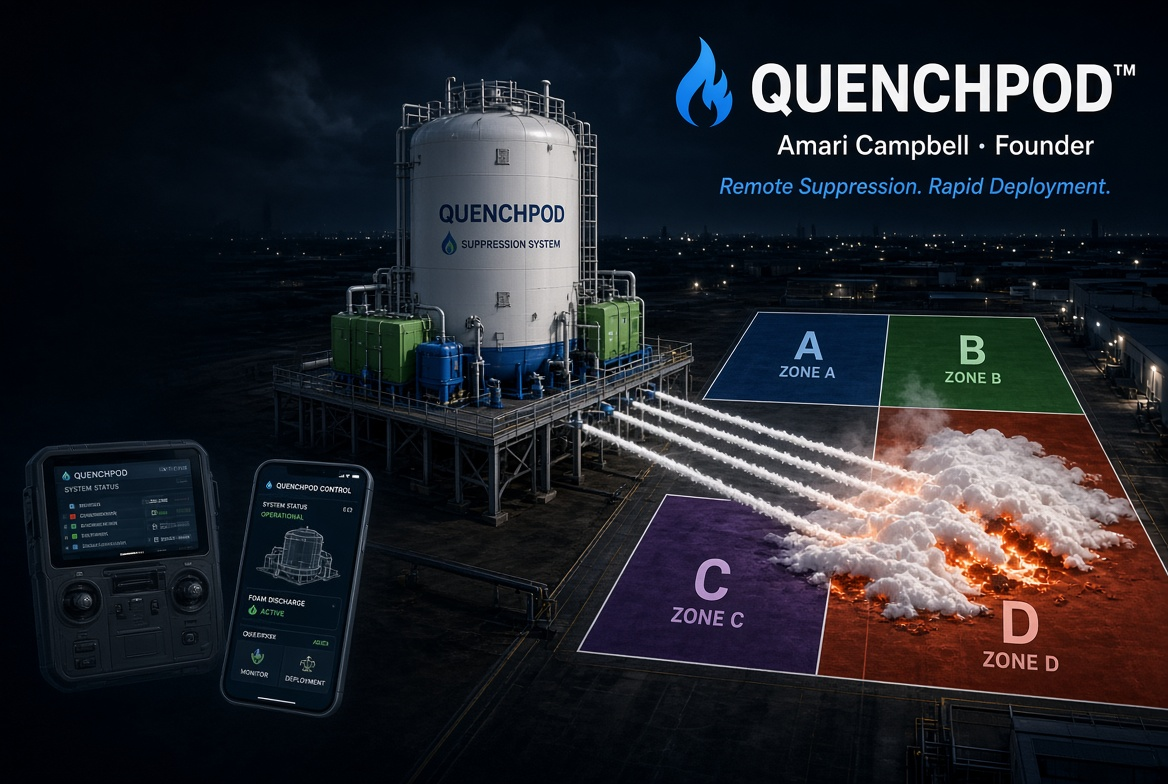
Zone-addressed activation
Up to 20 addressable units across a site. A fire in one zone activates that zone only — authorised by a deliberate two-stage action on the Clicker, with confirmation and a logged record. Concept interface; automatic activation follows certification.
Clicker™ 01
ArmedSelected zone
Zone D
6 units · plant room · alarm
Step 1 · hold to arm
Step 2 · deliberate action
Emergency zone activate
Credential · two-stage · confirmation returned
Zone A · Kitchen
StandbyZone B · Store
StandbyZone C · Charging
StandbyZone D · Plant room
Fire · armedActivation log
- 14:02:11Zone D · Unit 03 — heat rise detected, 118 °C
- 14:02:12Zone D raised to ALARM · alert to panel and Clicker
- 14:02:19Clicker 01 — operator credential accepted
- 14:02:24Zone D selected · arm held 0.5 s · ACTIVATE confirmed
- 14:02:25Zone D units 01–06 discharged · zones A–C untouched
Visualisations
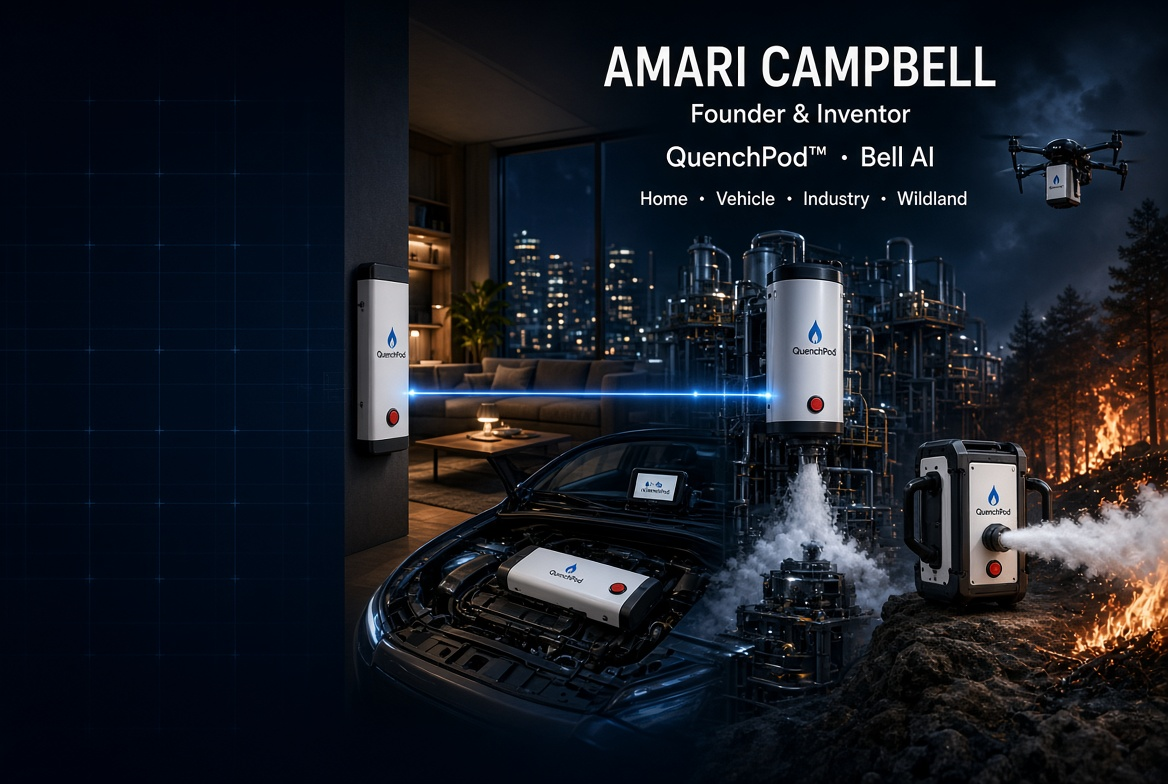
The concept in the field
How a QuenchPod is placed, fitted and delivered — concept imagery, not photographs of tested hardware.
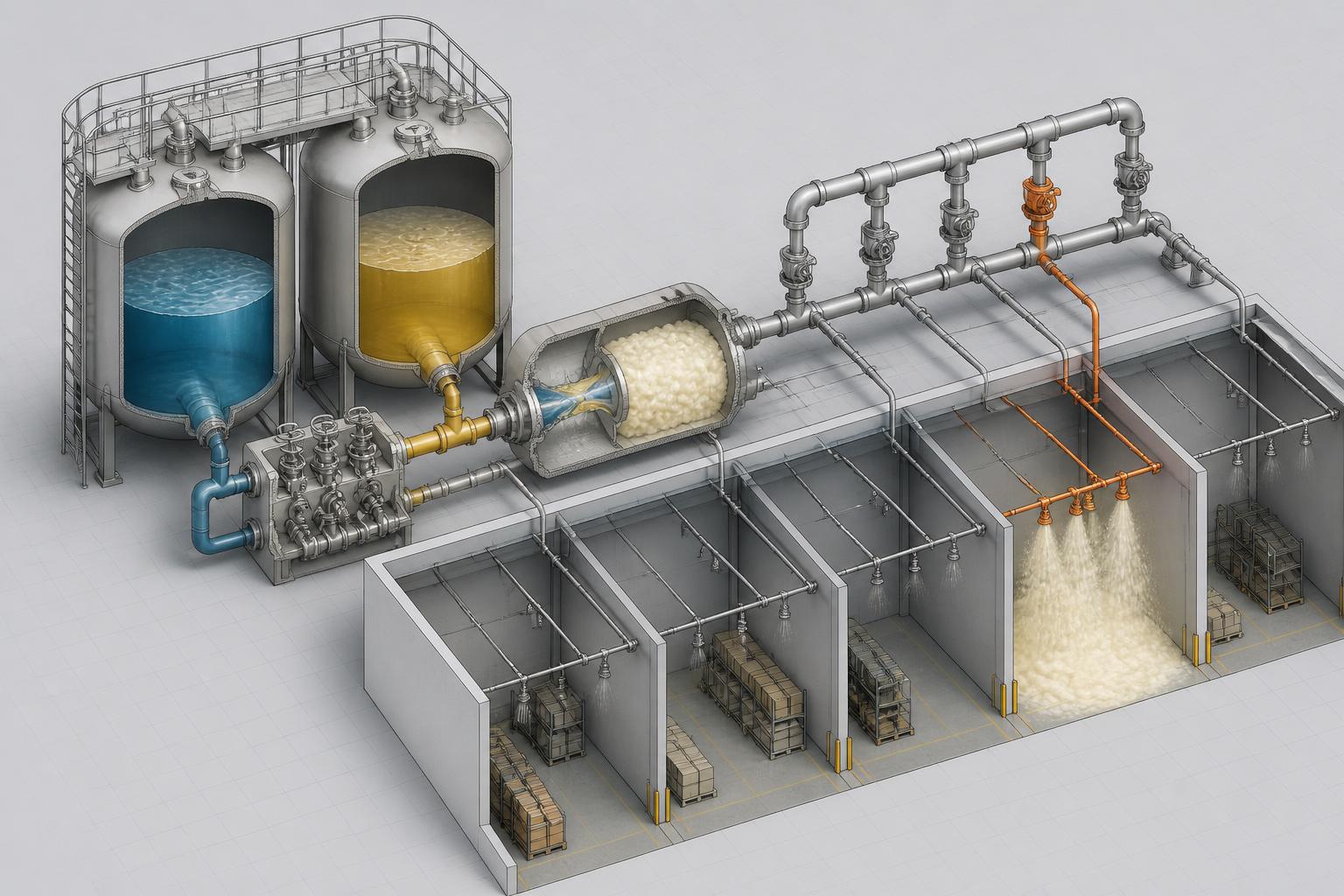
QuenchPod™ High-Risk Installation System
One central tank system. Every zone addressed on its own.
Two separately stored suppressant components, kept isolated in standby. On an authorised release they are brought together under controlled flow, aerated into fire-suppression foam and routed through a manifold to the selected zone only — for warehouses, factories, data centres, parking, infrastructure and wildfire-exposed estates.
QuenchPod™ WILD · High-risk installation
Large capacity. Low to the ground. Ready in the landscape.
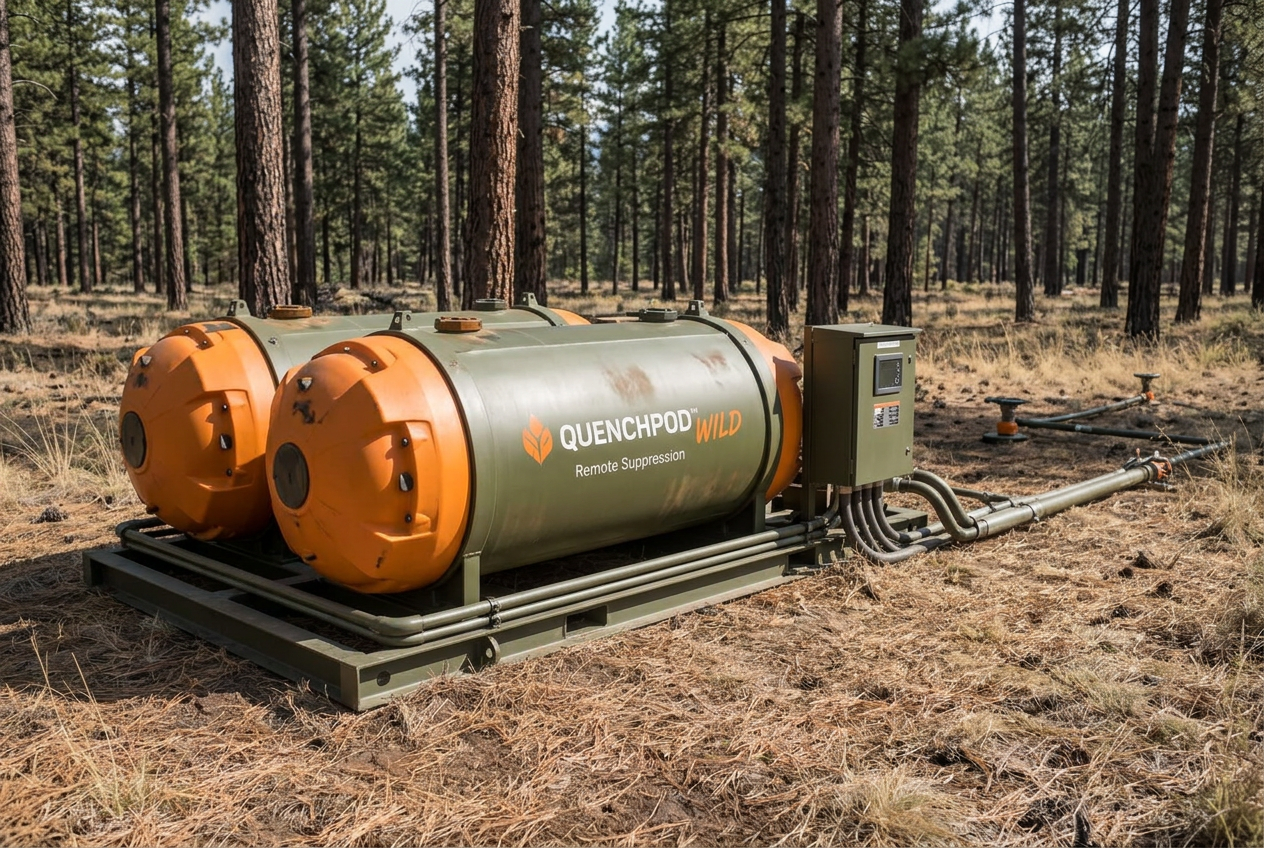
A substantial ground-level twin-tank system for wildfire-exposed estates, infrastructure corridors and remote high-risk properties.
- Low steel base for a stable, serviceable installation
- Separate contained components remain isolated in standby
- Monitored control cabinet and pipework feed positioned QuenchPod Nodes™
Concept visualisation — not tested or certified hardware.
Personal / Early-Stage Fires
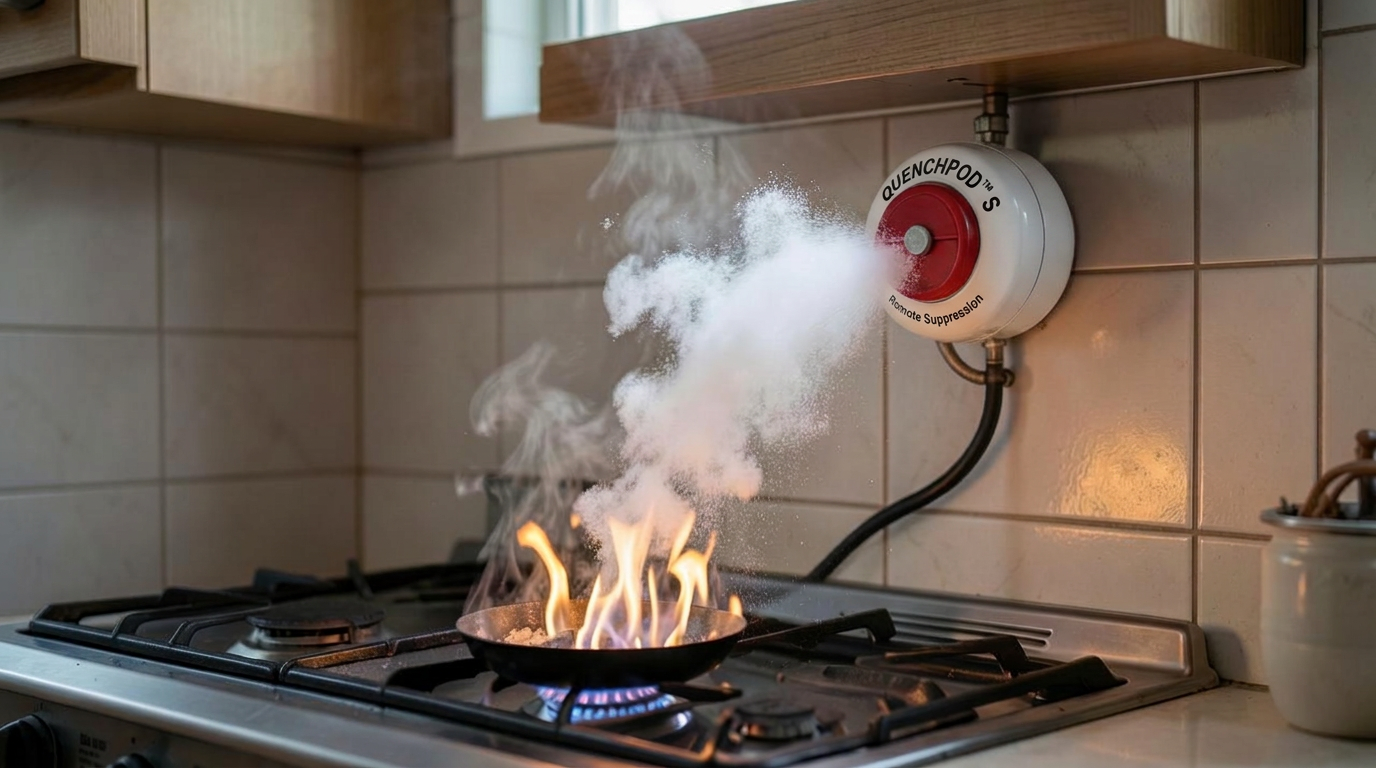
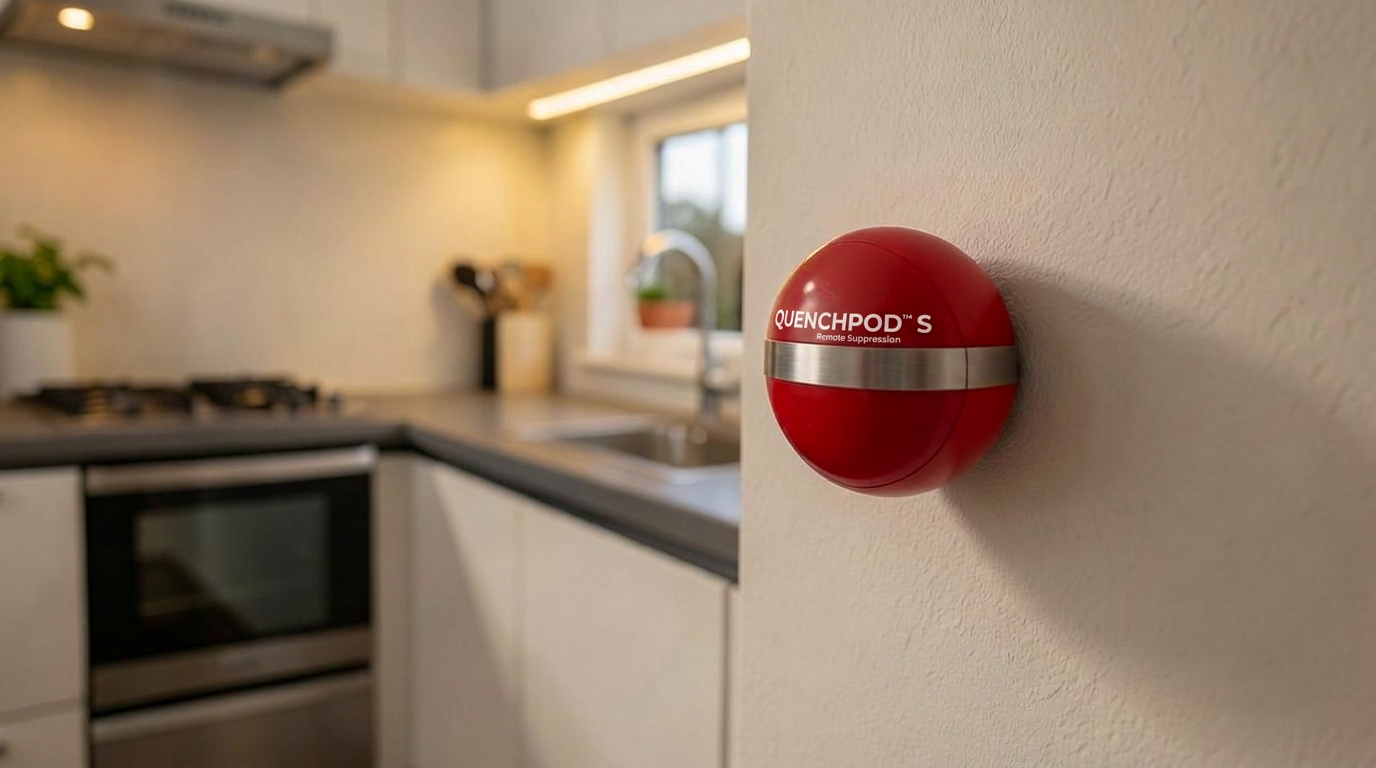
QuenchPod S
A compact unit intended for early-stage fires in homes, workshops, kitchens and small commercial spaces, where seconds decide whether a fire stays small.
- Hand-placed or thrown from a safe position
- Designed for cooking, electrical and waste-bin fires
- Sized for homes, vans, offices and workshops
Agent loadout
Wet chemical and ABC dry chemical powder
Smallest unit
Vehicle & Rescue
QuenchPod R
Built for roadside and vehicle incidents, allowing a crew to begin suppression while holding a greater stand-off distance from the hazard.
- Suited to vehicle, fuel and battery-fire scenarios
- Supports rescue access by knocking flames down first
- Carried on standard appliances and rescue units
Agent loadout
Fluorine-free (F3) Class B foam with cooling water
Compact response unit
Structure & Industrial
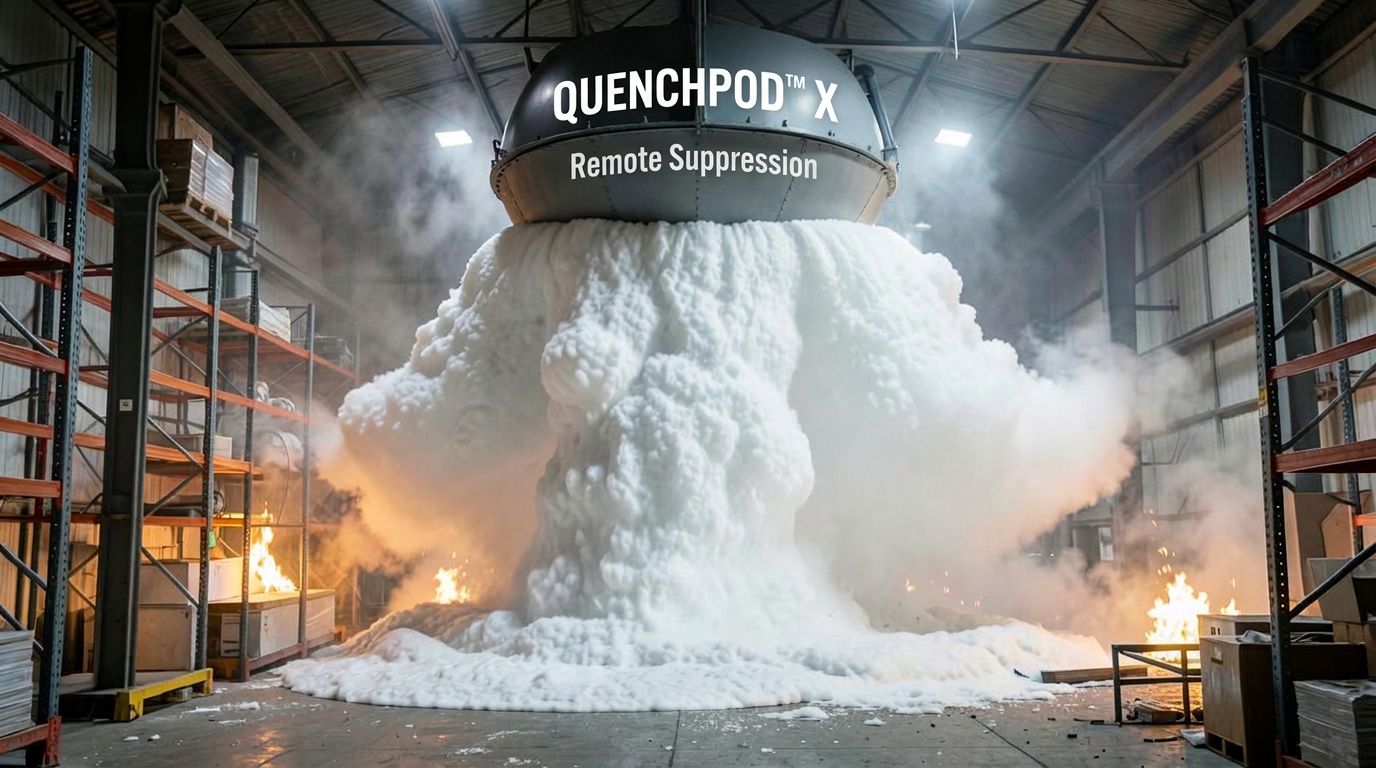
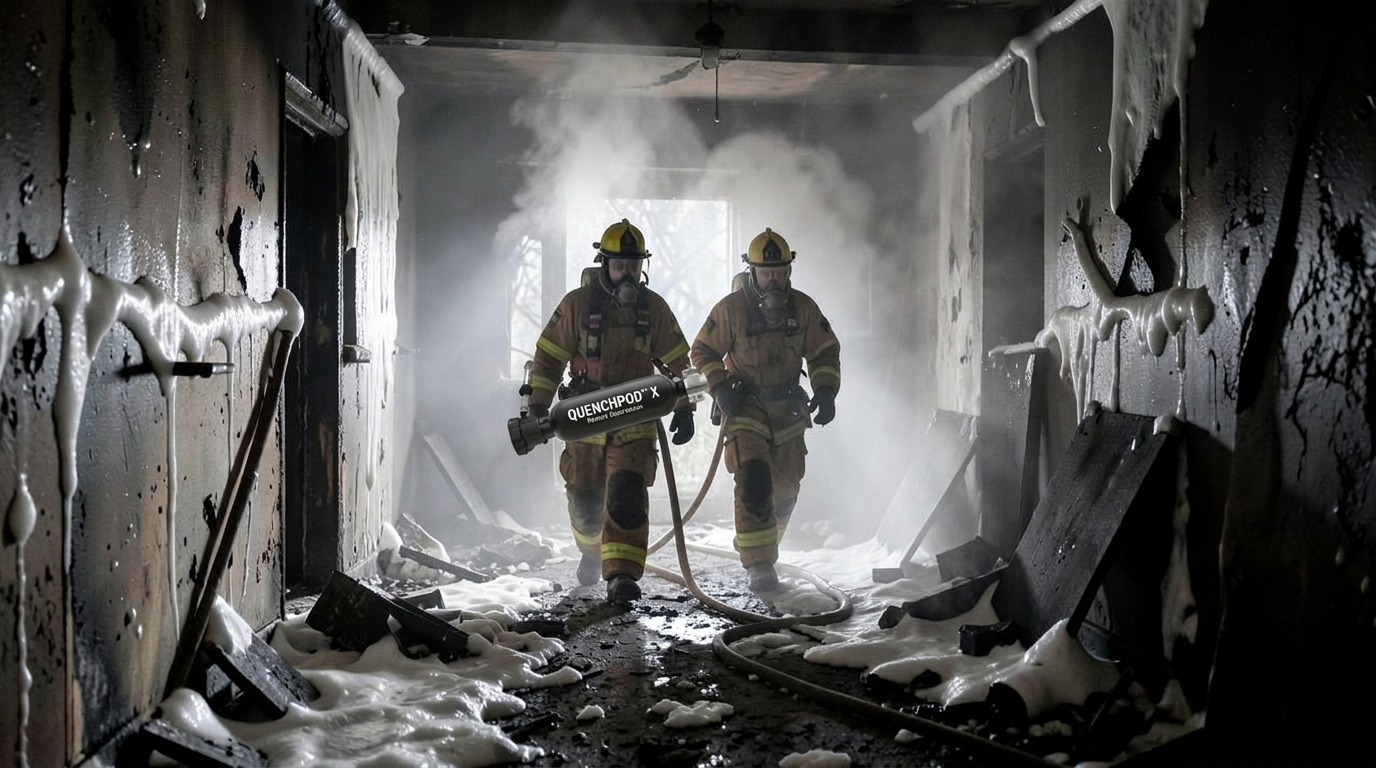
QuenchPod X
A larger platform intended to be placed into a heavily involved room or industrial space before crews commit to interior operations.
- Delivered remotely into rooms that are unsafe to enter
- Volume of agent matched to compartment firefighting
- Designed to support, not replace, conventional attack
Agent loadout
Compressed-air Class A foam (CAFS) with wetting agent
Heavy unit
Wildland & Forest Fires
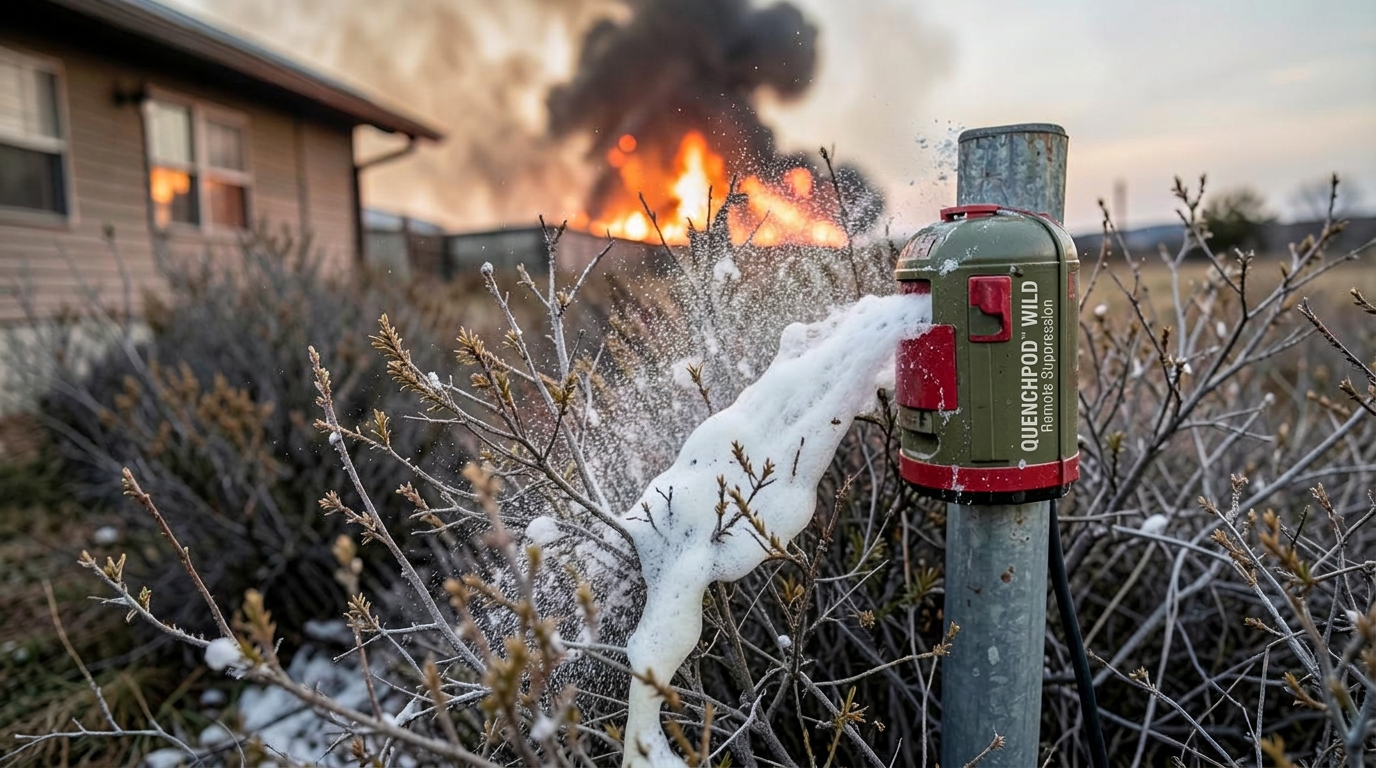
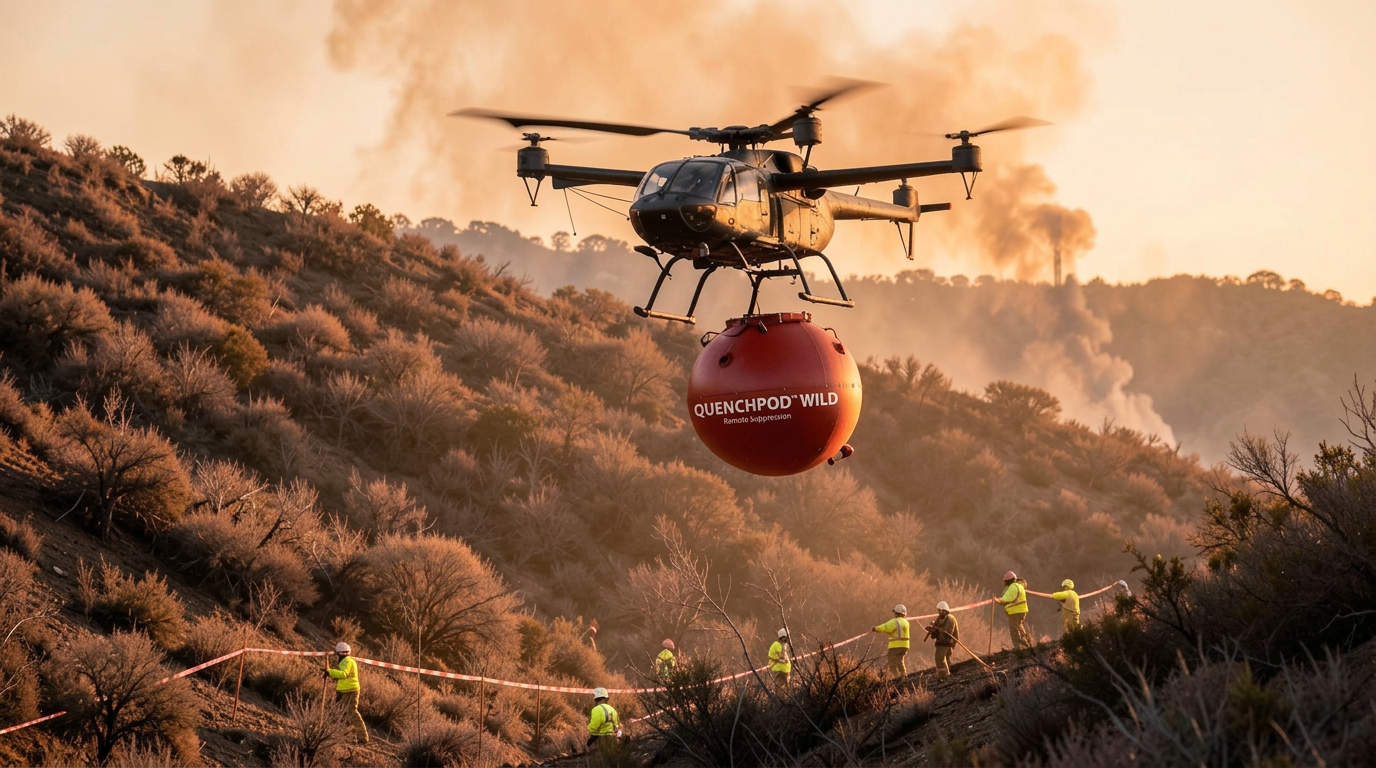
QuenchPod WILD
A ruggedised unit for vegetation fires, placed ahead of a fire front by ground crews or drones to treat fuel and reinforce containment lines.
- Clinging gel or foam coverage across brush and litter
- Drone placement into steep or unreachable terrain
- Used to strengthen containment and hold hotspots
Agent loadout
Water-enhancing (superabsorbent) gel and long-term retardant
Terrain unit
Drone & Aerial Deployment
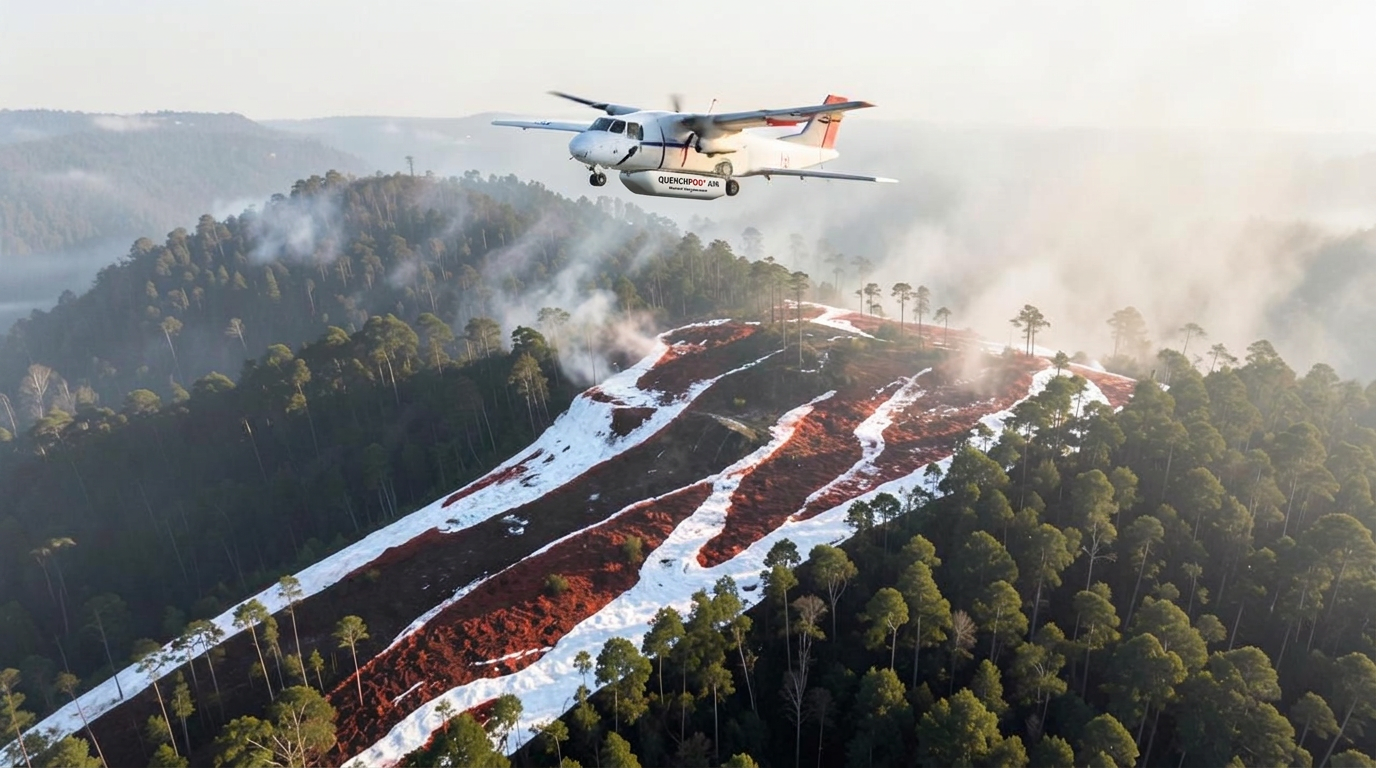
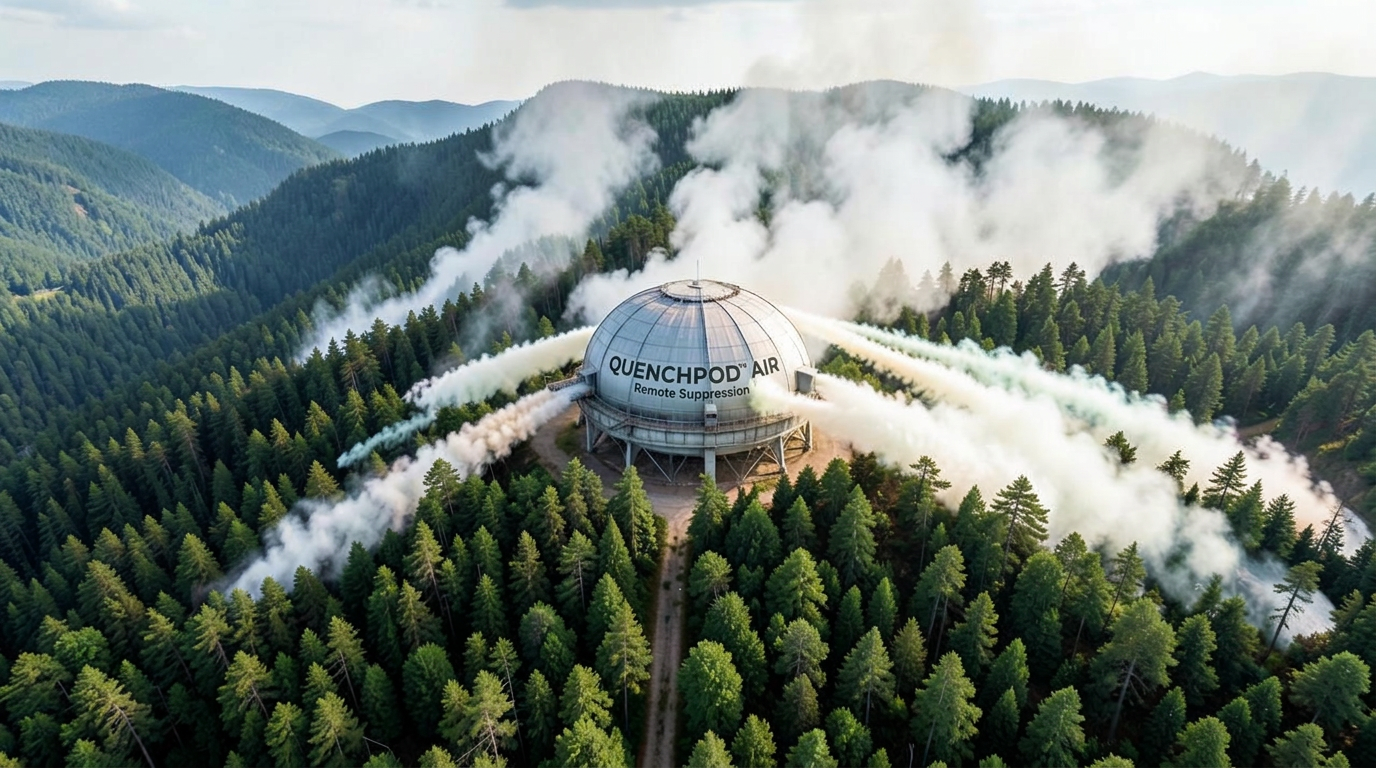
QuenchPod AIR
The largest concept unit, released from drones or a suitable firefighting aircraft to give distributed coverage across large or inaccessible fire zones.
- Distributed coverage rather than a single drop
- Intended for large, remote or fast-moving fires
- Coordinated from a command position with mapping
Agent loadout
Water-enhancing gel and long-term retardant
Largest unit
Market opportunity
TAM / SAM / SOM
$24B+ TAM | $5–8B SAM | $25–50M initial SOM
Total addressable market
~$24.1B
Global fire-suppression systems market in 2026 — extinguishers, sprinklers and other suppression systems across residential, commercial and industrial use. Projected to reach roughly $35B by 2033.
Serviceable available market
~$5–8B
The suppression segments QuenchPod's portable, installed and remote-deployment configurations could realistically compete in first: portable extinguishing, commercial and industrial suppression, installed targeted suppression, vehicle and transport, warehouses and data centres, and specialised remote suppression.
Initial obtainable market
~$25–50M
A reasonable early long-term commercial target, rather than claiming a percentage share of the entire global industry.
- Industrial applications were 48.9% of the ~$23B global suppression market in 2025.
- Fire extinguishers were 56.6% of that market by product.
- The global firefighting-foam market alone is roughly $1.0–1.1B — relevant to the proposed certified-agent partner channel.
We deliberately size against fire suppression (~$24.1B), not the broader ~$101.2B fire-protection market, which includes detection and alarms QuenchPod does not replace. SAM and SOM are estimates: QuenchPod would create a new category spanning several existing segments.
Current position
What exists today
Traction
Pre-revenue
No claimed customers, purchase orders or field deployments. The next milestone is supervised evaluation with fire-service and training-centre partners.
Certification
Not certified
No QuenchPod unit has completed independent testing or certification. Standards mapping, live burns and test-house submissions are funded programme work.
IP & product
Concept stage
Patent application drafted but unfiled. Product imagery, dimensions, performance and pricing remain design targets or planning estimates.
Competitive landscape
A new delivery layer for existing suppression budgets
Hand extinguishers
Strength: Low-cost, certified, familiar and widely distributed.
Gap: A person must stay close enough to aim throughout discharge.
QuenchPod: A familiar unit of purchase that can be placed, installed or remotely delivered.
Fixed suppression
Strength: Automatic, proven protection for unattended premises.
Gap: Fixed pipework is costly, disruptive and poorly suited to moving or remote risks.
QuenchPod: Targeted retrofit at the risk point, complementing rather than replacing fixed systems.
Thrown devices
Strength: Simple stand-off deployment and fast first attack.
Gap: Typically one deployment mode, limited control and dense prior art.
QuenchPod: Non-explosive release plus installed standby, remote delivery and addressable control.
Aerial suppression
Strength: Reaches large, inaccessible incidents.
Gap: High operating cost and broad drops with limited point control.
QuenchPod: Distributed, mapped placement through WILD and AIR programme deployments.
Business model
Hardware sale plus a recurring service layer
Capsule sales
€180–€9,000
Indicative range from QuenchPod S through AIR; volume and certification dependent.
Site packages
€3,500–€60,000
Indicative installed standby and multi-zone Network packages, including commissioning.
Recurring service
Annual + 5-year cycle
Inspection, recharge and replacement through the existing fire-equipment service channel.
Control layer
Priced per zone
Clicker™ units, supervision and activation logging for addressable installations.
All prices are concept-stage planning ranges, not offers, achieved revenue or forecasts.
Route to market
Prove credibility before pursuing volume
01 · Months 0–9
Prove
2–4 fire services + one training centre
Instrumented test data and named reference partners.
02 · Months 9–24
Certify
Agent partner, test house and industrial pilots
Certification submissions and validated installed-system requirements.
03 · Months 18–36
Land
Industrial, fleet, warehousing and infrastructure buyers
First direct deployments and fire-service procurement pathways.
04 · Months 30+
Scale
Distributors, agencies and aerial operators
Volume unit sales, programme sales and recurring service revenue.
The plan
Development timeline
Phase 0
Concept definition
Months 0–3
- Agent selection and performance targets per model
- Fire-service advisory panel and use-case validation
- Regulatory and standards mapping
Phase 1
Engineering & bench prototypes
Months 3–9
- Shell, chamber and dispersal design
- Non-explosive release mechanism bench tests
- First S and R scale prototypes
Phase 2
Live fire testing
Months 9–18
- Instrumented burn tests with a partner training centre
- Cooling and re-ignition performance measurement
- X and WILD prototypes, drone placement trials
Phase 3
Certification & field trials
Months 18–30
- Independent test-house certification programme
- Operational trials with volunteer fire services
- Manufacturing and tooling readiness
Phase 4
Production & AIR programme
Months 30+
- First production run of S, R and X
- Aerial deployment programme with aviation partners
- Distribution into fire services and agencies
Planning assumption only — phase durations to be confirmed against supplier, test facility and certification lead times.
Defensibility
Protect the architecture. Retire the risks.
IP roadmap
- Priority filing before any further public disclosure
- Novelty and freedom-to-operate search after filing
- PCT filing at 12 months and selected national phases at 30 months
- Trade marks for QuenchPod™, Network™ and Clicker™; design registrations for visible hardware
Certification takes longer or costs more
Engage the test house during Phase 1 and reuse evidence across the common platform.
Agent partner will not warrant the charge
Develop with a certified formulation partner from the first bench programme.
Dense thrown-device prior art
Anchor claims to the physical discharge architecture, installed system and control layer.
Conservative procurement cycles
Lead with supervised evaluation programmes and reference partners, not volume claims.
The budget
Development cost structure
Benchmark estimates built from published 2026 cost ranges for hardware engineering, injection-mould tooling, live fire testing, independent certification and PCT patent filing. They are planning ranges, not quotations — each line is to be confirmed with supplier, test-house and certification quotes before contract.
The budget
Cost by model and phase
Per model
Personal / early-stage. Smallest shell, wet chemical + ABC powder
Vehicle & rescue. Fluorine-free Class B foam and cooling water
Structure & industrial. Class A CAFS, largest certification load
Wildland. Gel and long-term retardant, drone carriage trials
Aerial. Aircraft carriage, release and aviation approvals
Per phase
S and R demonstrators, agent partner trials, first live burns
X development, full test programme, certification submissions
WILD and AIR, production tooling, first manufacturing run
The ask
The ask
QuenchPod™
Remote suppression. Rapid deployment. Safer firefighting.
- Development funding of $1.4M across Phase 1 and Phase 2, opening tranche $250k–$500k
- Fire-service partners for advisory input and live fire testing
- Engineering partner for shell and dispersal development
Concept-stage technology. Performance and applications subject to engineering, testing, regulatory review and certification.
26 / 27Appendix
Sources & basis of figures
Market sizing
Development costs
Technology and agents
- The immediate ask is $1.4M across Phase 1 and Phase 2, with a $250k–$500k opening tranche.
- Capital is paired with non-financial needs: fire-service test partners, an engineering partner and a certified agent partner.